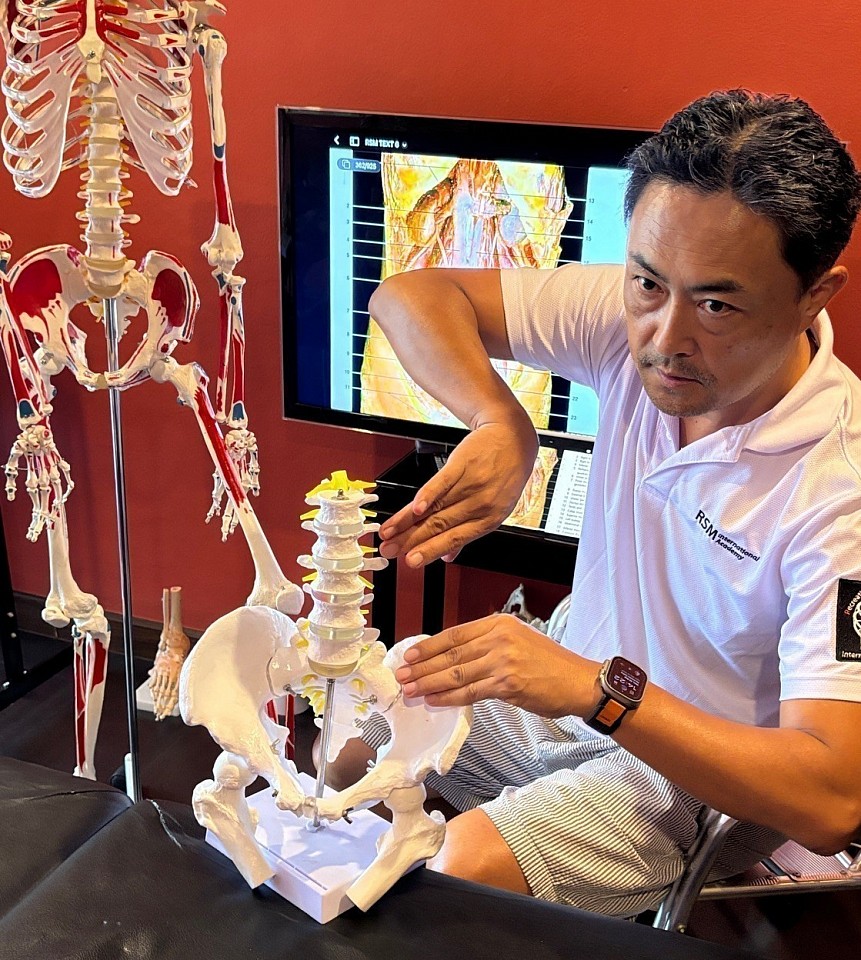
As a newcomer to the massage industry, the word "Orthopedic" sounded incredibly intimidating. I had just finished the Trigger Point and Deep Tissue courses at RSM International Academy, following the recommended path, but I almost didn't sign up for this one. I thought, "I'm just a beginner; spine mechanics and breathing are for physiotherapists or doctors." I was worried I would be out of my depth.
I am so glad I pushed past that fear. Taking the Orthopedic Massage Course for Spine Mobility and Breathing
was the best decision I’ve made. It took the scary, complex parts of the body and made them understandable, safe, and workable for someone at my level.
Demystifying the Spine
When I started, I viewed the spine as a "do not touch" zone because I was afraid of hurting someone. Hironori Ikeda (MSc Sports Medicine) changed that completely. He didn't just throw big words at us; he provided a clear introduction to orthopedic assessment skills that allowed me to actually see what was happening under the skin.
We used hundreds of visuals and diagrams. For a beginner, this was a lifesaver. It bridged the gap between the basic textbook drawings I saw in massage school and real life. I finally gained the practical anatomy knowledge for orthopedic massage needed to understand how a stiff rib cage can cause lower back pain or how breathing affects the neck.
Learning to "See" Before I Touch
Before this course, my strategy was basically "find the hard spot and rub it." I didn't know how to plan a session. This training taught me assessment protocols used in orthopedic massage that gave me a roadmap.
We looked at detailed case studies in orthopedic massage therapy, breaking down why a client was in pain and how to fix it step-by-step. Instead of guessing, I learned how to look at a client's posture and movement, identify the restriction, and treat it. It feels incredible to move from "guessing" to "assessing."
Safe Techniques for New Therapists
I was terrified that "orthopedic" meant cracking bones like a chiropractor. I was relieved to learn that RSM focuses on safe, gentle mobilization (LVLA).
We learned orthopedic massage techniques that are precise but gentle. We learned to mobilize the spine and ribs using the breath and slow movements, blending it with myofascial release. It felt safe for me as a therapist and safe for the client. Understanding the role of fascia in orthopedic massage helped me realize that I don't need to force the body; I just need to melt the restrictions that are holding the joints stiff.
Building a Real Career
One thing Ikeda Sensei said really hit home: "Clients can learn stretches on YouTube. They come to you for what they can't do themselves." As a beginner entering a competitive market, this scared me, but also motivated me.
I realized that just knowing how to do a "relaxing massage" isn't enough anymore. This course gave me the tools for developing treatment plans in orthopedic massage, which sets me apart from other juniors who just do standard routines. I now feel like I have a specialty.
The Learning Environment
Even though there were experienced physiotherapists and trainers in the class, I never felt left behind. The hands-on sessions were detailed, and the instructor corrected my hands constantly until I got it right. It felt like a fast-track residency.
If you are a beginner wondering if you are "ready" for advanced orthopedic training
, the answer is yes. This course didn't just teach me techniques; it gave me professional confidence. It stopped me from feeling like "just a student" and helped me start thinking like a clinician. It is, without a doubt, the most valuable training I have taken so far.