I’ve spent the last five years working in a clinical setting, treating patients every single day. On paper, I was "experienced," but inside, I was starting to feel that quiet, suffocating panic. I was stuck in a routine, terrified that I was becoming one of those practitioners who has the license but lacks the "hands" to actually make a difference. I knew the theory, but when a complex case walked in, I felt like I was just guessing through the skin.
That’s why I went to Chiang Mai for the Professional Sports Medicine Massage Course at RSM International Academy. This wasn't a vacation or a "relaxation" certificate. It was an intensive, high-pressure 8-day pivot point for my career.
From day one, the program stripped away the fluff. We dove into Trigger Point Therapy and Deep Tissue Massage, not as simple "pressure" techniques, but as evidence-based tools for clinical reasoning and postural correction. We studied Dynamic Myofascial Release and neurodynamics, learning how to actually manage nerve-related symptoms and chronic low back pain by understanding how tissue behaves under load. For the first time, my palpation didn't feel like guesswork; it felt like a diagnostic tool.
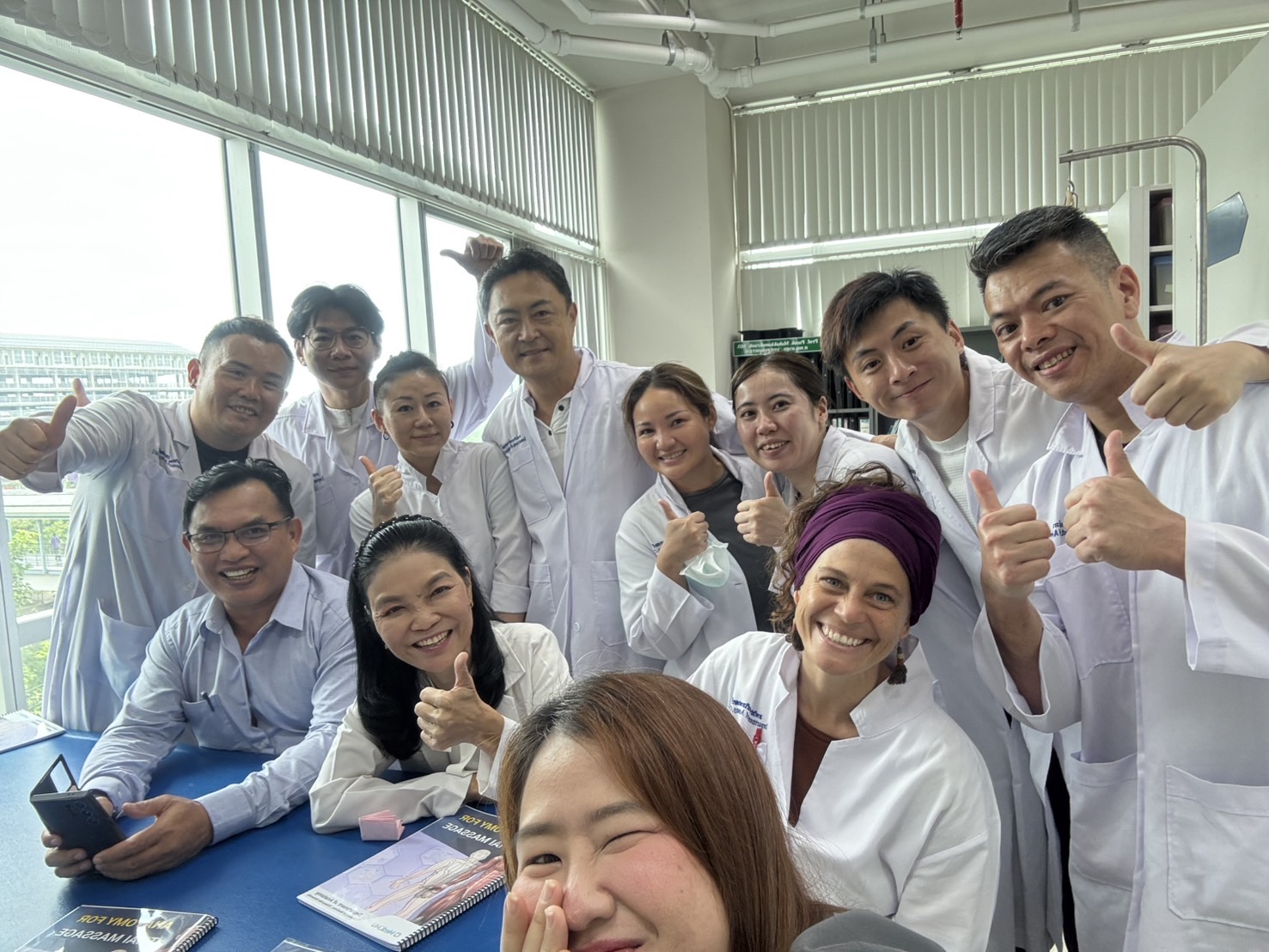
The absolute turning point was the Cadaver Anatomy Course at Chiang Mai University’s Faculty of Medicine. Standing over two human specimens, guided by university professors, I finally saw the structures I had only ever seen in 2D diagrams. Seeing the sciatic nerve and the deep external rotators with my own eyes changed how I touch people. You can’t get that kind of "clinical certainty" from a textbook or a YouTube video.
The program is led by Hironori Ikeda (MSc Sports Medicine). Having a mentor who has trained senior therapy teams at world-renowned five-star wellness resorts like Chiva-Som and optimized the conditioning of elite athletes—ranging from Spanish professional basketball players to top fighters in Croatia—was the reality check I needed. He brings a rare level of academic and clinical authority, having earned his Master’s at the University of Tsukuba, ranked #1 in Asia for Sports Science.
His expertise in clinical palpation is so profound that he coordinates the very cadaver labs we attended, and his scientific contributions include serving on the Japan Industrial Standards (JIS) committee for human ergonomics and developing patented orthopedic technology with AIST. He bridges the gap between biomechanical theory and what actually happens under your fingertips using evidence-based methodologies, such as the Balance Ball Yoga system validated by research at the University of Cagliari.
I’ll be honest: the course is brutal. I was up studying two or three hours every night just to keep my head above water. I saw people who didn't put in the work fall behind immediately. It’s a professional environment designed for those who are tired of being "average" and are terrified of their skills stagnating.
I came back with more than just a certificate. I came back with the ability to explain pain mechanisms to my clients, to assess with logic, and to see measurable changes in my treatments. If you’re a young professional feeling like you’re losing your edge in a sea of paperwork and routine, don’t underestimate this program. It didn't just improve my technique; it gave me my confidence back.
phone:+66985175990
adress:〒50300, Mueang Chiang Mai District, Chiang Mai, Chang Peauk 30/10-11 CHARUENSUK Road